
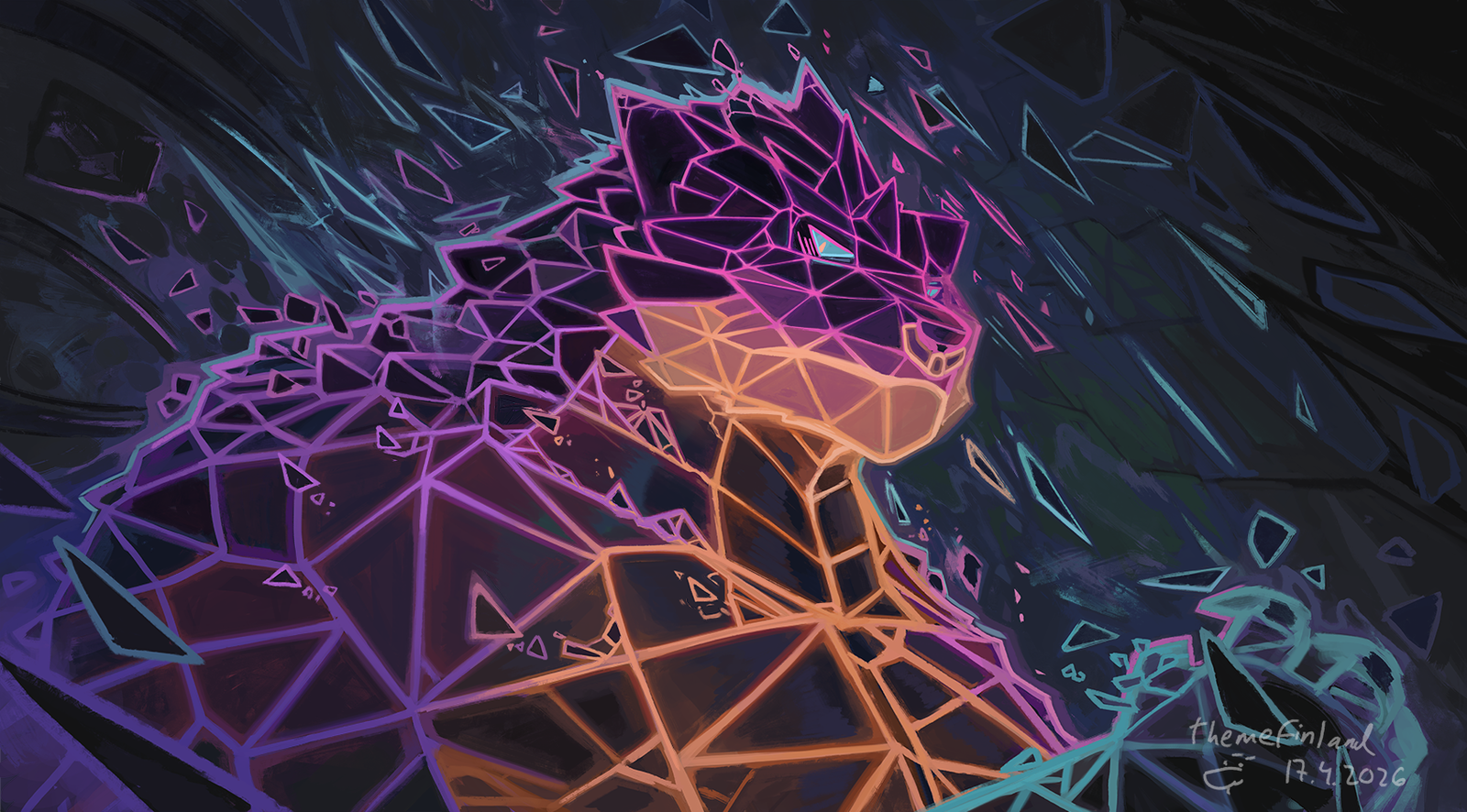

A much longer blurb.
Three days passed, and I hadn’t seen it since.
Not for lack of evidence. Each night I’d leave a ration bar on the grating near the crates. Unwrapped, because I didn’t know if it could manage the packaging with those paws. Beside it, a small saucepan filled to the brim with water from the cabin tap.
Every time I came back, the bar was gone and the water level had dropped by an inch or two, the surface still and undisturbed, as if it had never been touched at all. No crumbs. No wet prints on the decking. No shed fur. No sign of where it went or how it got there.



I’d crouch by the grating and peer into the sub-deck, but the crawlspace was empty. Just cables and piping and shadow. I checked the corners, the gap behind the remaining crates, the recess where the ramp mechanism folded in. Nothing. For all I knew the thing had figured out how to get inside the walls themselves. Slipped between hull panels into some cavity I didn’t know existed on my own ship. The Calyx was old enough to have secrets I’d never found, and apparently so was whatever was living in it.
I don’t even know why I’m searching for it. At first it was an idle worry that it’d chew up the cables or something, but it seems too smart for that. Maybe now it’s just… curiosity? Been years since I’ve had a guest on board. I’ll admit, some company isn’t unwelcome—even if it is uninvited.
At the same time, the firmness of the gun through my pillow brings some comfort when I try to sleep. It’s there, just in case.
It helped last night. The overhead light dims on a timer—a slow, gradual fade. It’s the one automated system on this ship that works exactly as intended, every single time. The amber glow retreats, and above me, the ceiling comes alive with its quiet theatre. Hundreds of tiny LEDs embedded in the panelling, scattered in a pattern that’s close enough to a real star field to fool the tired eye.
I never worked out how to turn them off, and at some point I stopped wanting to. They’re not accurate. They don’t correspond to any real constellation. But they make the ceiling feel further away than it is. They make the room feel less like a box.
But as I laid on my bunk that night, counting the stars above, I noticed something. The faintest orange glow, trickling out from between the bars of a vent halfway up the wall.
There are always lights flickering on and off on a ship. Status indicators and the like. They’re even on the parts you don’t see; need to know during maintenance that the power’s been diverted, that the right pipe is pumping oxygen and the left’s recycling CO2. Sometimes those lights are yellow. Sometimes they’re a shade of amber—not by design, but because the fitting’s old and nobody replaces the diffuser.
Was there always a light in that corner? And I just never paid any attention to it till now? I’d never heard of Expies glowing, but come to think of it, you don’t hear much about them at all.
I’ve taken to listening more carefully. Sitting in the cabin with the fold-out table down and a mug of coffee going cold and just… listening. The ship’s idle hum. The tick of the heating conduit. The occasional creak of the hull adjusting to thermal drift. And sometimes—maybe—the faintest scrape of something shifting its weight in a place I couldn’t see.
Or maybe that was just the ship being old.